

Prefer a printable version? Get the professionally formatted, medically reviewed guide here:
The “Skyscraper” Promise: This is not just a brochure. This is the most comprehensive guide on the web regarding bariatric surgery options in Mexico vs. the USA. We cover everything from the “Liver Shrink Diet” to specific financing plans. Bookmark this page now.
Deciding to undergo weight loss surgery is one of the most significant decisions you will ever make. But with so much conflicting information online, Finding the best Bariatric Surgery Guide for your weight loss journey can feel impossible, which is why we created this Complete Bariatric Surgery Guide for 2026.
At BeLiteWeight, we believe clarity is just as important as the surgery itself.
This comprehensive bariatric surgery guide is your “Master Resource.” Whether you are researching the difference between a Sleeve and a Bypass, or you need a bariatric surgery guide to understand financing options in Mexico vs. the USA, everything you need is right here.
This Bariatric Surgery Guide is designed to be your single, bookmarkable resource as you compare procedures, costs, and recovery options.
| Surgery Type | Avg. Weight Loss | Avg. Price (Mexico) | Best For… |
|---|---|---|---|
| Gastric Sleeve (VSG) | 60-70% Excess Weight | $5,800 – $6,800 | High BMI & Volume Eaters |
| Gastric Bypass (RNY) | 70-80% Excess Weight | $7,500+ | Sweet Eaters & Severe Reflux |
| Mini Bypass | 75-85% Excess Weight | $6,800+ | Metabolic Issues & Revisions |
***Data – Bariatric Surgery Guide
Navigating your weight loss options requires a trustworthy Bariatric Surgery Guide that simplifies complex medical data into actionable steps. Our Complete Bariatric Surgery Guide is designed to help you compare the best procedures, understand the real costs of surgery in 2026, and determine which path fits your unique health goals. Whether you are looking for a Bariatric Surgery Guide to gastric sleeve requirements or a detailed cost comparison between the USA and Mexico, this resource serves as your definitive, safe roadmap to a healthier life.
Surgery is only a tool. The success of that tool depends on how you prepare for it. Before we even discuss prices or procedures, we must address the preparation phase. This is often where patients feel the most lost.

Liver Shrinking – Diet Bariatric Surgery Guide
You may have heard of the pre-op diet. This is not just to torture you before surgery; it is a medical necessity. Most patients with high BMI have a condition known as “Fatty Liver.”
The liver sits right on top of the stomach. If the liver is enlarged, it makes it difficult and dangerous for the surgeon to access the stomach. To ensure a safe laparoscopic procedure, you must shrink the liver.
Note: At BeLiteWeight, our nutritionists provide you with a specific, day-by-day meal plan for this phase so you are never guessing.
Bariatric surgery changes your relationship with food forever. You are not just changing your stomach size; you are changing your coping mechanisms. We encourage all patients to ask themselves:
This is the #1 barrier to entry for weight loss surgery. Let’s break down the economics of healthcare in 2025.
In the United States, the sticker price is rarely the final price. You might see a quote for $15,000, but that often excludes:
We operate differently. We know that financial stress hinders recovery. That is why our packages in Mexico are transparent.
Our ~$5,800 Gastric Sleeve Package Includes:
We partner with leading medical financing institutions to offer plans with low monthly payments and terms up to 5 years. You do not need to have the full cash amount upfront.
Check your financing eligibility here (Does not affect credit score) »
Patients often ask, “Is it safe if it’s cheaper?” The lower cost is not a reflection of lower quality. It is a reflection of:
Fill out our secure eligibility form to receive a personalized quote.
Many of our patients have never traveled to Mexico for medical care. The fear of the unknown is often greater than the fear of the surgery itself. Let’s walk through the logistics of a typical BeLiteWeight journey, step-by-step, so you know exactly what to expect.
Your journey usually begins by flying into a major US border city or directly into the Mexican destination (depending on your specific facility choice).
The BeLiteWeight Difference: You are never left standing on a curb hailing a taxi. We arrange professional ground transportation. A driver who knows you by name picks you up from the airport. This is a “hand-holding” experience from the moment you land.
There is a misconception that Mexican hospitals are outdated. The reality is often the opposite. Because private medical tourism is a booming industry, our facilities are equipped with state-of-the-art laparoscopic technology that rivals or exceeds many US community hospitals.
We highly encourage patients to bring a companion (spouse, parent, or friend). Having emotional support is crucial.
Accommodation: Most of our packages facilitate arrangements for your companion to stay nearby or with you (depending on the facility rules). They are part of the team. They can help you walk the hallways post-op (a key to reducing gas pain) and keep your spirits high.
The return trip is handled with the same care. We ensure you have all necessary medical documentation to cross the border smoothly (if driving) or to fly home. You are given a specific “Fit to Fly” letter if required by airlines.
Forget the swimsuit; this isn’t a beach holiday. Here is what our veteran patients recommend packing:
Before diving into the details, use this chart to see which procedure aligns with your health goals and budget.
| Feature | Gastric Sleeve | Gastric Bypass | Mini Bypass |
|---|---|---|---|
| Best For… | Volume Eaters Patients wanting a simpler procedure[cite: 37]. | Sweet Eaters Patients with severe Reflux (GERD)[cite: 37]. | Metabolic Issues High BMI patients needing power[cite: 28]. |
| Weight Loss | 60-70% of excess weight | 70-80% of excess weight | 75-85% of excess weight |
| Hospital Stay | 2 Nights | 2-3 Nights | 2 Nights |
| Reversible? | No (Permanent) | Difficult but possible | Yes (Easier reversal) |
| Cost (Mexico) | View Sleeve Price » | View Bypass Price » | View Mini Price » |
The Vertical Sleeve Gastrectomy (VSG), commonly known as the “Gastric Sleeve,” has skyrocketed in popularity over the last decade. It has largely replaced the Lap-Band® as the go-to procedure for patients seeking a balance between safety, recovery time, and effective weight loss.
The concept is elegant in its simplicity. The surgeon removes approximately 80% of the stomach. The remaining portion is stapled into a long, thin tube that runs along the inner curve of the stomach. The shape resembles a banana or a shirt sleeve—hence the name.
Key Surgical Facts:
Many patients believe the Sleeve works solely because the stomach is smaller (Restriction). While true, this is only half the story. The Sleeve is actually a powerful metabolic surgery.
The portion of the stomach that is removed (the fundus) is the body’s primary factory for a hormone called Ghrelin. Ghrelin is often called the “Hunger Hormone.” It signals your brain that it is time to eat.
🎓 The Science: When we remove the fundus, Ghrelin levels drop plummet. BeLiteWeight patients frequently tell us, “I just forgot to eat.” This chemical change allows you to make healthy choices without fighting the constant, gnawing physical hunger you have battled for years.
For patients concerned about scarring, BeLiteWeight offers an advanced variation of the Sleeve called SILS.
Traditional laparoscopy uses five small entry points. SILS is performed almost exclusively through a single point of entry, usually through the belly button. This results in virtually invisible scarring once healed. Not all surgeons possess the skill to perform SILS, but our surgical teams are highly experienced in this advanced technique.
The Sleeve is often the best choice for:
For general clinical information on bariatric procedures, see the Cleveland Clinic bariatric overview. Learn more.
The Roux-en-Y Gastric Bypass (RNY) is the grandfather of bariatric surgery. It has been performed for over 50 years and is the most researched weight loss operation in medical history. If the Sleeve is a “restrictive” surgery, the Bypass is a “restrictive + malabsorptive” surgery.
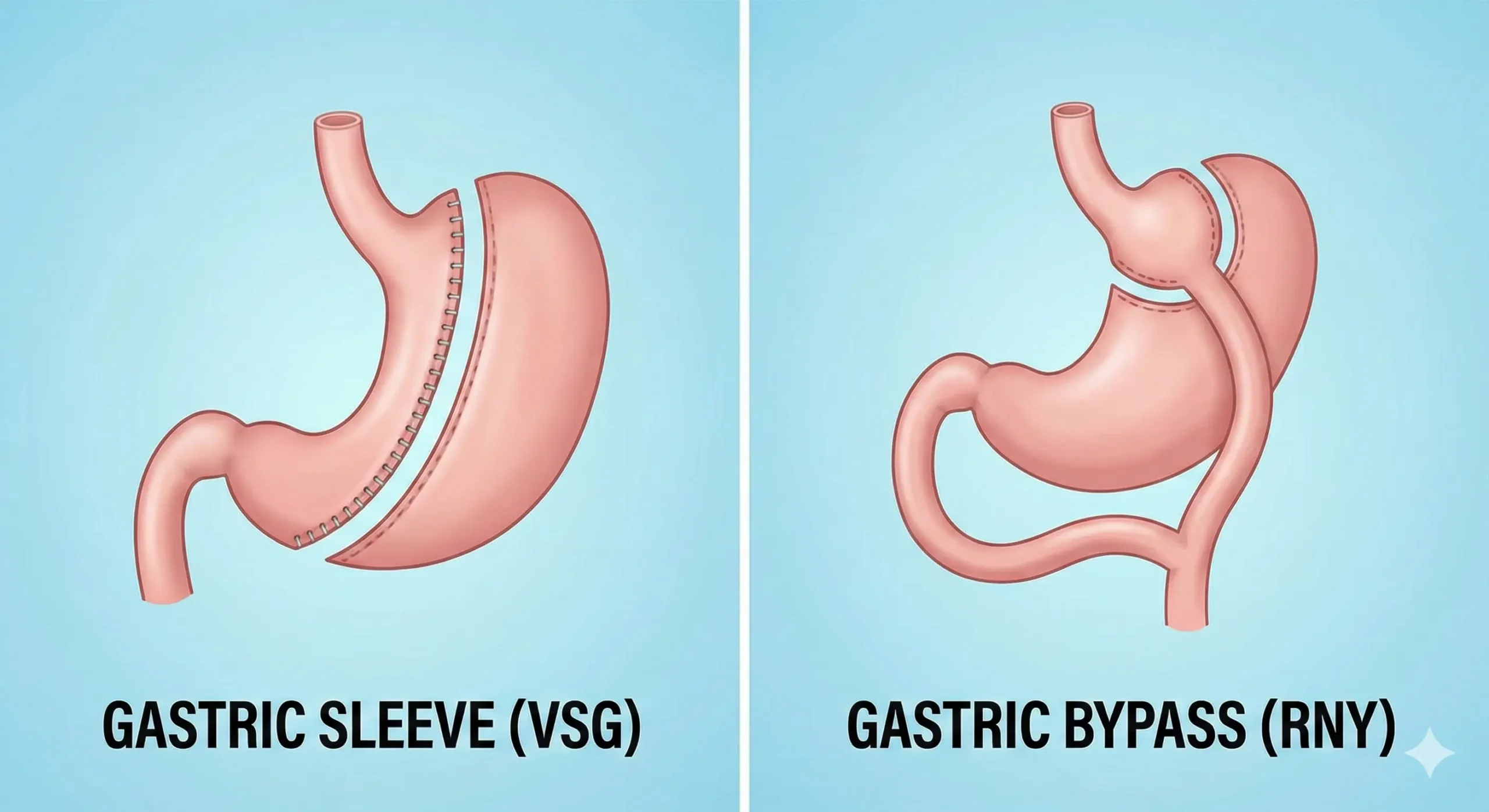
Gastric Sleeve VSG Gastric Bypass RNY Bariatric Surgery Guide
As part of our Bariatric Surgery Guide, our coordinators offer personalized, all-inclusive pricing for your transformation in minutes.
The Bypass is more complex than the Sleeve because it reroutes your plumbing.
Because food skips the duodenum, your body has less time and surface area to absorb calories and fats. This provides a “double punch” against obesity: you eat less, and you absorb less of what you eat.
You may have heard horror stories about “Dumping Syndrome.” At BeLiteWeight, we frame this differently: Dumping Syndrome is a tool, not a side effect.
If a Bypass patient eats high-sugar or high-fat foods (like ice cream or fried chicken), the sugar rushes into the small intestine too quickly. This causes nausea, sweating, and a rapid heartbeat. While uncomfortable, it acts as a powerful behavioral deterrent. It physically prevents you from relapsing into bad dietary habits. For patients with a severe “sweet tooth,” this negative reinforcement can be the key to long-term success.
The Gastric Bypass is remarkably effective at putting Type 2 Diabetes into remission—often within days of surgery, long before significant weight is lost. The rerouting of the intestines changes how gut hormones signal insulin production. Many of our patients leave the hospital no longer needing their insulin shots.
| Feature | Gastric Sleeve (VSG) | Gastric Bypass (RNY) |
|---|---|---|
| Weight Loss Speed | Steady, consistent | Rapid initially |
| Acid Reflux (GERD) | Can worsen reflux | Cures reflux (Best Choice) |
| Reversibility | No (Stomach is removed) | Difficult, but technically possible |
| Vitamin Needs | High | Very High (Must be strict) |
The Duodenal Switch (DS), also known as the Biliopancreatic Diversion with Duodenal Switch (BPD/DS), is the most complex bariatric procedure. However, for the right patient, it produces the most significant weight loss of any surgery available today.
While the Gastric Bypass creates a tiny pouch, the DS keeps a larger portion of the stomach (similar to the Sleeve). The real power comes from the intestinal rerouting. The DS bypasses a massive portion of the small intestine.
At BeLiteWeight, we see hundreds of patients every year who are unhappy with a previous weight loss surgery performed elsewhere or years ago. The most common scenario is the Lap-Band®.
If you had a Lap-Band inserted 10 years ago and are now experiencing reflux, slippage, or weight regain, it is not your fault. The data now shows that the Lap-Band has a high long-term complication rate. The device often needs to be removed.
Revision surgery is highly specialized. It involves operating on scar tissue and altered anatomy. Our surgeons are experts in these “rescue” procedures.
This is our most common revision. We remove the Lap-Band and any scar tissue, then perform a standard Gastric Sleeve. This removes the foreign object and restores the metabolic advantage of the Sleeve.
Other common revisions include converting a Sleeve to a Bypass (usually to cure severe acid reflux) or revising a Bypass to a DS for further weight loss.
Bariatric surgery isn’t for everyone. It is a tool for those who need medical intervention to reclaim their health.
We need to stop thinking about bariatric surgery as “Weight Loss Surgery.” It is arguably more accurate to call it “Metabolic Disease Resolution Surgery.”
If you suffer from any of the following conditions, your insurance or your doctor might classify the surgery as medically necessary. Here is the science on how surgery impacts these specific diseases.
This is the most miraculous aspect of bariatric surgery. Studies show that Gastric Bypass can put Type 2 Diabetes into remission in up to 80% of patients. For more on long-term diabetes outcomes after bariatric surgery, see the
American Society for Metabolic and Bariatric Surgery patient resources.
How? It is not just about eating less sugar. The surgery reroutes the intestines, which alters the secretion of “incretin” hormones (like GLP-1). These hormones tell your pancreas to produce insulin more effectively. Many patients wake up from surgery with normal blood sugar levels before they have lost a single pound. It effectively “resets” the metabolic clock.
Sleep apnea is a silent killer, straining your heart every night. It is largely caused by excess soft tissue in the neck collapsing the airway.
The Impact: As you lose weight, the fatty deposits in the neck disappear.
Carrying excess weight forces your heart to pump harder to move blood through your body. It also hardens the arteries.
The Impact: Within 6 months of surgery, over 60% of patients are able to reduce or completely eliminate their blood pressure medication. This drastically lowers your 10-year risk of stroke and heart attack.
PCOS is the leading cause of infertility in women, and it is intrinsically linked to insulin resistance and obesity.
The Impact: Weight loss surgery is one of the most effective treatments for PCOS. By resolving insulin resistance, testosterone levels drop, and regular ovulation returns.
Physics is simple: For every 1 pound of body weight, there are 4 pounds of pressure on your knees. If you lose 100 pounds, that is 400 pounds of pressure removed from your knees with every step.
Many patients cancel their scheduled knee replacement surgeries after bariatric surgery because the pain simply vanishes.
You might be a good candidate if:
Surgery takes a few hours. The journey lasts a lifetime. Here is a realistic look at what the first year looks like for a BeLiteWeight patient.

Life After Surgery – Bariatric Surgery Guide
You are recovering. Your abdomen will feel sore, similar to doing 1,000 sit-ups.
Diet: Clear liquids only (Water, broth, sugar-free jelly).
Goal: Hydration. You must sip water constantly to avoid dehydration.
The swelling is going down. You are transitioning to thicker liquids and “mushy” foods.
Diet: Protein shakes, yogurt, cottage cheese, scrambled eggs.
The “Stall”: Around week 3, many patients stop losing weight for a few days. Do not panic. Your body is just adjusting to the rapid change.
This is the magic window. The weight falls off rapidly—sometimes 3-5 pounds a week.
Diet: Solid foods are reintroduced. Focus on protein first, veggies second, carbs last.
Energy: You will likely feel a surge of energy you haven’t felt in years as the heavy weight lifts off your joints.
By now, you have likely lost 60-80% of your excess weight. The rapid loss slows down, and you enter maintenance.
The Trap: It is possible to regain weight if you start “grazing” (eating small amounts of high-calorie food all day). This is why the habits you build in Month 1 are critical for Year 10.
We believe an informed patient is a safe patient. Bariatric surgery is major abdominal surgery. While the risk of death is exceedingly low (lower than gallbladder surgery), complications can occur.
We hope this bariatric surgery guide has given you the clarity you need to take the next step.
You have read the science. You have seen the costs. You understand the timeline.
The only thing left is to ask yourself: Where do I want to be one year from today?
Do not let money or fear stop you from reclaiming your health. At BeLiteWeight, we have guided thousands of people just like you through this exact journey.
Get Your Free Evaluation Today »
Or call us directly at 1-800-215-6497 to speak to a counselor now.
In our 20+ years of experience, we have heard it all. Here are the honest answers to the questions you might be too afraid to ask your doctor.
Q: Will I ever be able to eat “normal” food again?A: Yes. The “mushy” phase is temporary. Within 6-9 months, most patients eat regular textures—chicken, salads, fruits. The difference is the volume. You will eat a saucer-sized portion, not a platter. You will likely find that very sugary or greasy foods no longer appeal to you.
Q: Can I drink alcohol?A: Proceed with extreme caution. After surgery (especially Bypass), your metabolism of alcohol changes.
1. Absorption: You get drunk much faster. One glass of wine might hit you like three.
2. Calories: Alcohol is “liquid sugar.” It is the easiest way to regain weight.
3. Transfer Addiction: Some patients replace food addiction with alcohol addiction. We recommend avoiding alcohol entirely for the first year.
Q: What about soda and carbonation?A: This is a hard “No” for life. Carbonation expands the stomach. In a normal stomach, you burp. In a tiny sleeve or pouch, that gas gets trapped and causes intense pain. It can also stretch your pouch over time, undoing your surgeon’s work.
Q: Will I have a lot of loose skin?A: This depends on your age, genetics, and how much weight you lose. If you lose 150lbs, yes, loose skin is likely.
Our advice: Treat the loose skin as a “badge of honor.” It means you won. Shapewear helps immensely. If it bothers you after 2 years, plastics (tummy tucks) are an option, but focus on the health victory first.
Q: Will I lose my hair?A: Probably, yes. It is called Telogen Effluvium. It happens 3-6 months post-op due to the shock of surgery and rapid weight loss.
The Good News: It is temporary. You will not go bald. The hair follicles are just “sleeping.” Ensure you are hitting your protein goals (60-80g/day) and taking your Biotin and Zinc supplements to minimize this.
Q: What happens if I have a complication back home in the USA?A: This is a valid fear. Before you leave, you should inform your primary care physician (PCP) about your surgery. While US surgeons can be hesitant to touch another surgeon’s work, emergency rooms are legally required to treat you. However, BeLiteWeight provides you with detailed operative reports to give to your local doctors so they know exactly what was done.
Q: Can I stretch my stomach back out?A: Yes. The stomach is a muscle. If you consistently overeat (pushing past the “full” signal), you can stretch the pouch. This is why surgery is a tool, not a magic wand. If you respect the tool, it will work for life.
Dr. Jose Rodriguez Villarreal
Board-Certified Bariatric Surgeon
This article has been medically reviewed for general accuracy and safety. It is not a substitute
for personal medical advice. Always consult your own physician or bariatric team about your
specific situation.
For evidence-based guidance, visit BeLiteWeight resources.
Learn more from NIDDK about healthy lifestyle and nutrition.
1-800-215-6497
1-800-215-6497